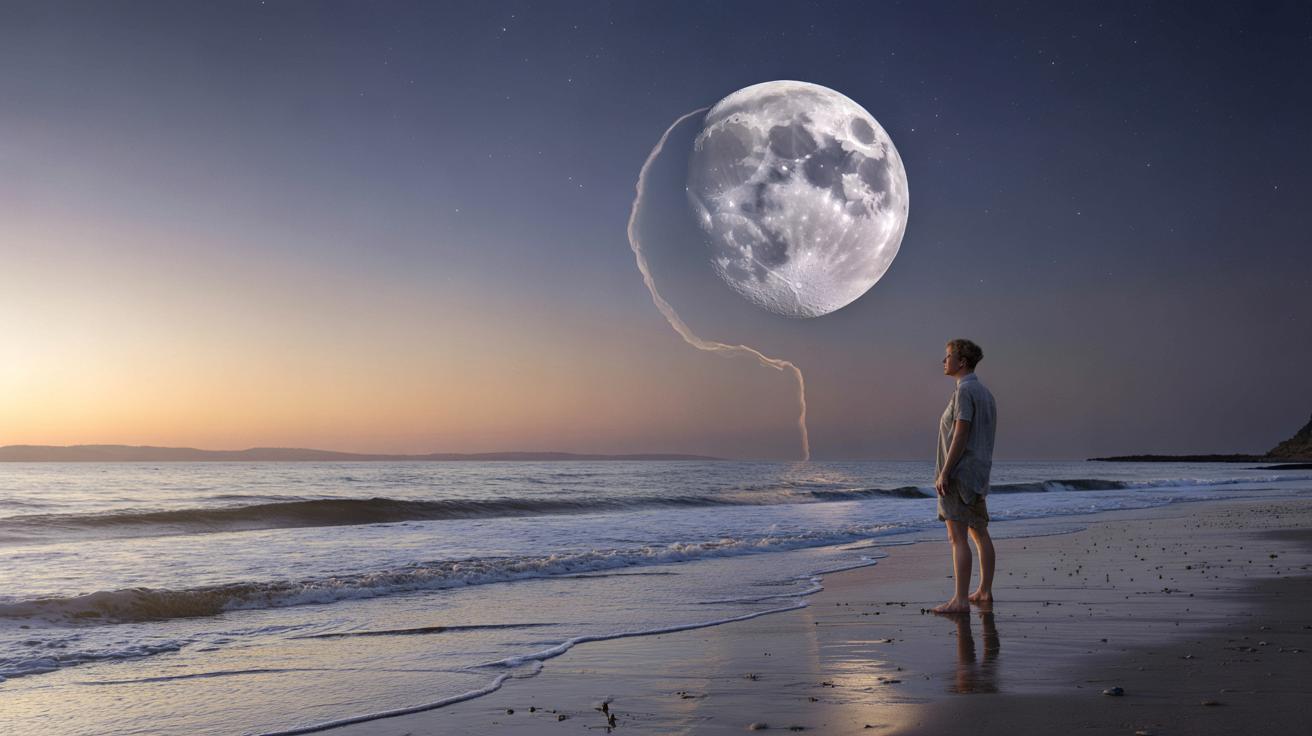
On a calm summer evening, stand by the sea and really watch the tide.
The water creeps up the sand, licks at your shoes, then slowly slides back, dragging foam and tiny shells with it. Kids run along the edge, chasing waves they’ll never quite catch. Above them, the Moon hangs like a patient metronome in the sky, silent and pale, yet pulling millions of tonnes of water back and forth without breaking a sweat.
What almost nobody notices in that ordinary scene is this: the Moon is slipping away.
Not dramatically, not like in a disaster movie. Just millimetre by millimetre, year after year.
And as it leaves us, it’s quietly stretching our days and softening the tides.
Very slowly.
But forever.
The Moon is leaving, and our days are swelling
Right now, the Moon is drifting away from Earth at about 3.8 centimetres per year.
That’s less than the rate at which your fingernails grow, yet it’s enough to rewrite the rhythm of our planet. Over millions of years, this small outward shuffle has been turning Earth’s spin into a lazy spiral, slowing the rotation and making our days longer.
Billions of years ago, a “day” on Earth may have lasted just 5 or 6 hours.
Later, during the age of the dinosaurs, it was closer to 23.5 hours.
Today we’re at 24 hours, edging upward, so slowly that no human will ever feel the change in a single lifetime.
You can actually see proof of this cosmic drift in solid rock.
Geologists study ancient coral reefs and tidal mud deposits that grew in daily, monthly, and yearly layers, like tree rings. These formations capture patterns of tides and seasons, frozen in stone. When researchers count the bands and do the maths, they find more “days” squeezed into a year the further back they go.
One famous set of 620‑million‑year‑old rocks from Namibia shows around 400 days in a year.
Same orbit around the Sun, same overall year length.
Just shorter days, because Earth was spinning faster under a slightly closer Moon.
The reason is simple physics, not magic.
As the Moon pulls on our oceans, it raises bulges of water that try to line up directly under it. But Earth is spinning faster than the Moon orbits, so those bulges are dragged slightly ahead of the exact Earth–Moon line. That offset acts like a brake. It slows Earth’s rotation and transfers energy to the Moon’s orbit, pushing the Moon a touch farther out.
Energy doesn’t vanish; it changes form and place.
Each tide is a tiny trade: we lose a sliver of spin, the Moon gains a sliver of distance.
*The slowest clock in your life is not on your wrist, it’s written into the length of the day itself.*
Softer tides, quieter seas, and a different future
As the Moon edges away, its grip on our oceans weakens.
Tides are still powerful, still shaping coasts and feeding ecosystems, but the long arc is clear: over geological time, the tides are getting gentler. Models suggest that hundreds of millions of years from now, high and low tides will be less dramatic than today, the range between them smoothed out.
➡️ After years of plastic cleanup, marine ecosystems started repairing themselves
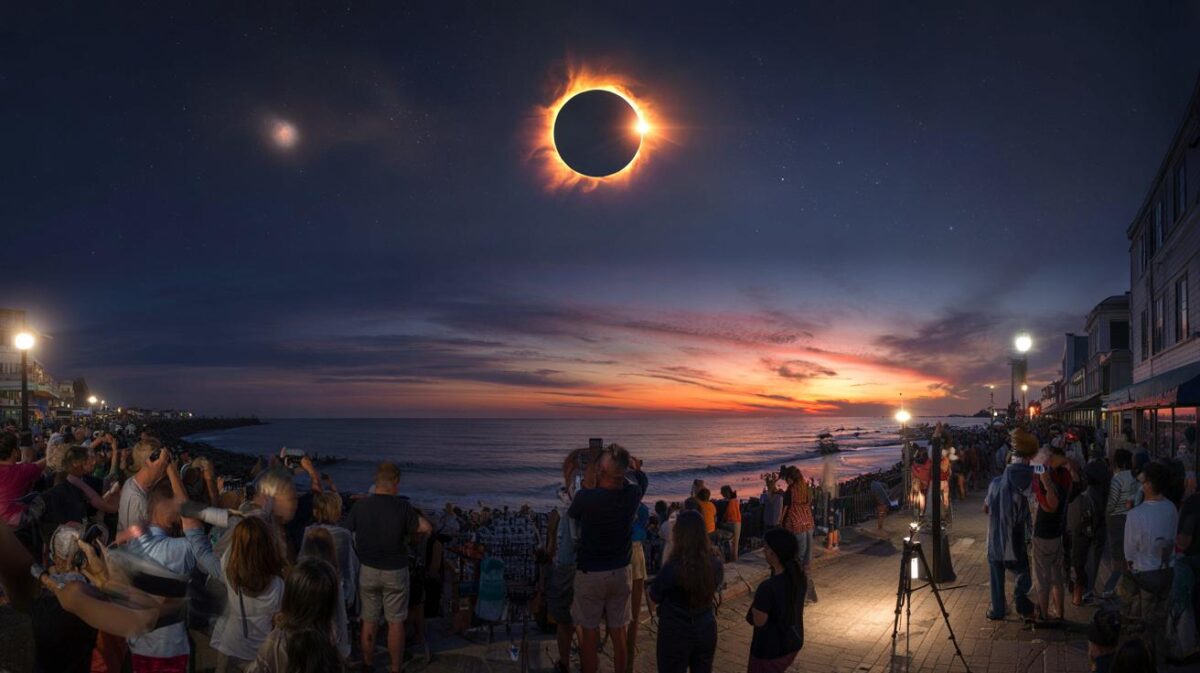
➡️ Day Will Turn To Night With The Longest Total Solar Eclipse Of The Century
For coastal ecosystems that live by the pulse of the tide, this long fade matters.
Salt marshes, mangroves, and tidal flats depend on regular flooding and draining.
Change the height or timing of those tides and you rewrite which species thrive, which disappear, and how coastlines build or crumble.
There’s a human angle too, even if our timescale is tiny compared to the Moon’s.
We build harbours, tidal power plants, and sea walls assuming a certain pattern of tides. Over millions of years, regions with today’s strong tidal currents could become calmer pockets of sea. Places known for dramatic tidal ranges—like the Bay of Fundy in Canada, or Mont-Saint-Michel in France—might one day look strangely ordinary.
Of course, other forces work faster than the Moon’s slow retreat.
Climate-driven sea-level rise, storms, erosion: those hit on human timescales.
Against those, the Moon’s quiet softening of the tides is like a background whisper.
From a physics perspective, this entire process is called tidal evolution.
Earth and the Moon are locked in a gravitational dance, each deforming the other slightly, exchanging energy and momentum through those tides and internal flexings. The same story plays out across the Solar System: Mars and its moon Phobos, Jupiter and Io, Saturn and its rings.
Over time, this dance tends to push systems toward “tidal locking,” where one side always faces the other, like our Moon does now.
If the clock ran long enough and nothing else interfered, Earth’s rotation and the Moon’s orbit might eventually sync up too, one face of Earth staring at the Moon forever.
That future is so distant it’s basically science fiction, but the first steps toward it are happening already, one slowed day at a time.
How to feel a 3.8-millimetre-per-year miracle
There’s something strangely comforting about watching a process you can’t control, only notice.
Next time you’re out at night, look for the Moon and try a small “experiment” in perspective. Instead of seeing a flat disc, picture a heavy companion slowly marching away along an invisible track, powered by the friction of our own tides.
You can even visit one of the sites that let us measure this drift.
Since the Apollo missions, astronauts have left reflectors on the lunar surface. On some nights, scientists shoot laser pulses at them and time the light’s round trip, down to fractions of a millimetre. That’s how we know the Moon is backing away at 3.8 cm per year, not just guessing from theory.
A lot of people quietly assume this is all science so abstract that it has nothing to do with their lives.
We’ve all been there, that moment when your brain taps out at “gravitational interaction” and wanders off to think about dinner. Yet this story folds right back into daily feelings you already know: long summer evenings, the tug of the tide against your legs, the way a full Moon seems to pull at moods and sleep.
Let’s be honest: nobody really sits on the beach thinking about the angular momentum of the Earth–Moon system.
But the same forces that shape the maths shape the memories.
Once you know that, a quiet walk by the water starts to feel like a front-row seat to a very slow miracle.
“Standing on a beach, you’re watching an ancient machine at work,” says one planetary scientist. “The waves at your feet, the Moon in the sky, and the length of your day are all tied together by invisible strings of gravity.”
- How fast the Moon moves away: about 3.8 cm per year, measured by laser.
- How it changes our days: Earth’s rotation slows, adding roughly 1.7 milliseconds per century.
- What happens to the tides: the Moon’s weaker pull leads to gradually smaller tidal ranges over very long times.
- Where we see the past: ancient corals and tidal rocks reveal shorter days and more days per year.
- Why it matters emotionally: it’s a reminder that even the most solid things in our lives are quietly changing.
A planet that never sits still, under a Moon that never stops leaving
Once you start noticing it, the whole Earth feels less like a static ball of rock and more like a living mechanism caught mid‑movement. The continents drift, climates swing, species come and go. Above it all, the Moon keeps its slow retreat, lengthening our days by fractions of a heartbeat and calming the tides wave by wave.
For our species, the numbers sound almost meaningless.
A few extra milliseconds per century? A subtle softening of tides over tens of millions of years? Yet there’s something humbling in knowing our “normal” is just a snapshot in a much longer story. Dinosaurs lived under shorter days and wilder tides; some distant future life may inhabit a world with lazier oceans and longer twilights.
The next time you feel like everything in your life is rushing, remember that somewhere above you a celestial brake is permanently pressed.
The same Moon that lights late‑night walks and anchors myths and lullabies is also stretching the day you live in, one microscopic increment at a time.
You might not notice the change in a month, or a year, or a generation.
Yet if you look up at that pale disc and imagine it a little closer, a little brighter, a little more powerful in the deep past, you’re suddenly part of a story that runs from the first tides to the last.
And that’s the quiet magic: even standing still on a beach, you’re moving with the Moon.
| Key point | Detail | Value for the reader |
|---|---|---|
| The Moon is drifting away | Measured at about 3.8 cm per year using Apollo laser reflectors | Turns an abstract idea into something concrete and measurable |
| Days are getting longer | Earth’s rotation slows by around 1.7 milliseconds per century | Reframes “24 hours” as a changing feature of our planet, not a fixed rule |
| Tides are slowly weakening | Weaker lunar pull means gentler tidal ranges over geological timescales | Helps readers see everyday tides as part of a vast, evolving system |
FAQ:
- Is the Moon really moving away from Earth?Yes. Laser measurements from reflectors left by Apollo astronauts show the Moon is receding at about 3.8 centimetres per year.
- Will the Moon ever leave Earth’s orbit completely?Not in any time frame that matters to humans. Long before that could happen, the Sun’s evolution into a red giant will transform the entire Solar System.
- Are our days actually getting longer?Yes, by roughly 1.7 milliseconds per century. It’s far too small to feel in a lifetime, but it’s clear in long-term geological records.
- Does the Moon’s drift affect tides today?On human timescales, the effect is tiny compared to storms or sea-level rise, but over millions of years the general trend is toward slightly weaker tides.
- Could this change harm life on Earth?Life has already adapted to huge shifts in day length and tidal strength over billions of years. The current changes are extremely gradual, giving ecosystems vast time to adjust.