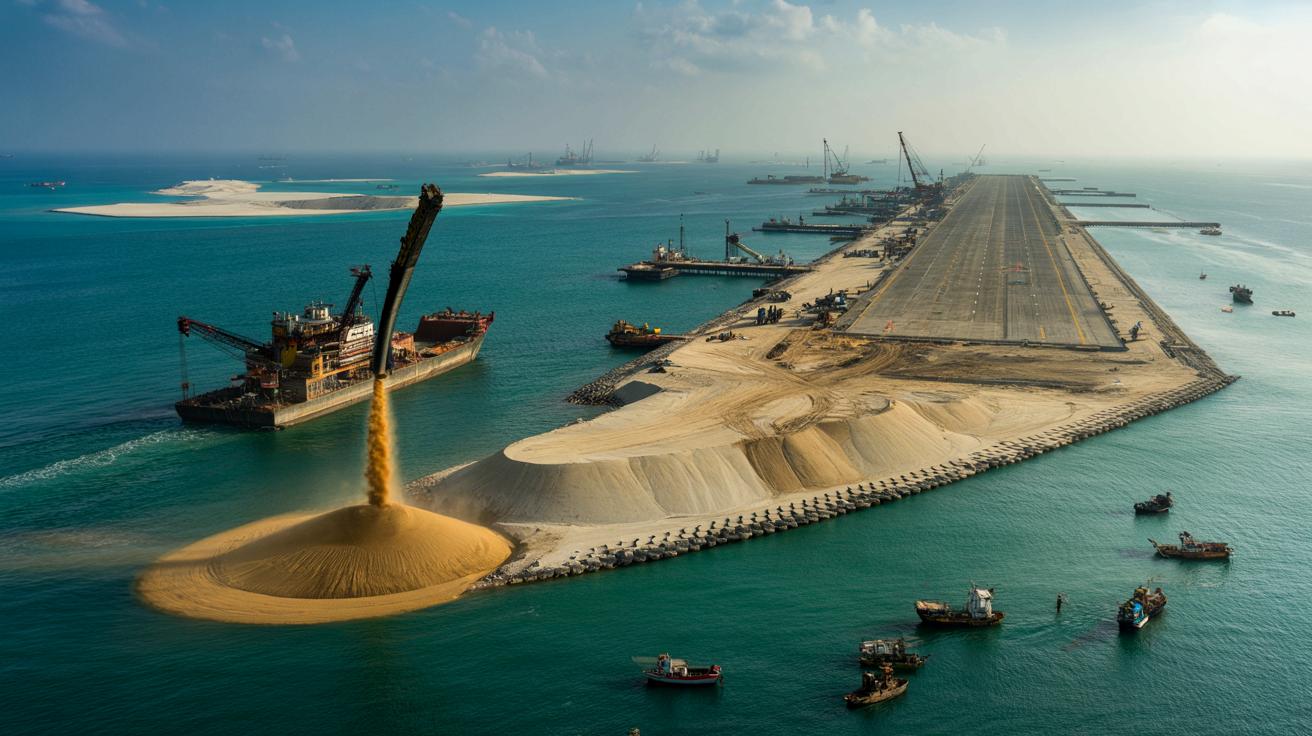
On a gray morning in the South China Sea, the horizon looks wrong. Where old fishing charts show only shifting waves and scattered reefs, a chain of pale, sandy shapes now breaks the line between sky and water. Cranes move like slow insects. Dredgers throb in the distance, sucking sand from the seafloor and spewing it out in long, mustard-colored plumes.
The smell is salt and diesel, the soundtrack a mix of waves, engines and shouted orders in Mandarin. A Filipino fisherman squints at the new coastline and shakes his head. “That wasn’t there last year,” he mutters.
These islands were never meant to exist.
From empty sea to concrete frontier
The story begins with an idea that feels almost unreal: you can redraw the map by dumping sand. Around 2012, China quietly began using colossal dredging ships to suck sand, silt, and coral fragments from the seabed and pile them on top of half-submerged reefs.
First came the faint outlines. Then shallow sandbars. Then, shockingly fast, runways and ports.
From the air, you see turquoise water sliced by perfect gray airstrips and neat hexagons of breakwaters. The speed of change leaves neighboring countries, and frankly much of the world, struggling to keep up.
Ask old sailors about the Spratly or Paracel Islands and they’ll talk about lonely rocks where birds outnumber people. Now, satellite images tell a different story: more than 3,200 acres of new land carved out of the ocean, much of it by China alone.
On Fiery Cross Reef, what used to be barely visible at high tide has become a massive artificial island with a 3,000-meter runway, hangars, radars, and harbor facilities. The names sound almost poetic — Mischief Reef, Subi Reef, Cuarteron — yet the structures are anything but romantic.
They look like the skeletons of future cities dropped into the middle of contested waters.
The basic method sounds simple on paper. You park a “cutter-suction dredger” next to a reef, grind up the seabed, and pump the slurry through floating pipes until a new patch of ground rises above the waves. Then you stabilize it with rock, concrete, and steel.
In reality, it’s a staggeringly industrial process, tied to energy, logistics, and raw political ambition. **China has spent over a decade scaling this up into a kind of island factory line**, deploying some of the world’s largest dredging fleets.
Land reclamation isn’t new — Dubai, Singapore, and the Netherlands have done it for years — but doing it this fast, this far from home shores, and this deeply inside disputed waters? That’s what changes everything.
How you build a brand-new island from nothing
If you zoom in technically, the process starts with choosing the reef. Not all coral outcrops are equal. Engineers look for shallow features that sit just below the surface, solid enough to act as a natural foundation.
Next comes the dredger: a hulking ship with a rotating cutter head that chews into the seabed like a mechanical jaw. Sand and crushed coral are sucked up, mixed with water, and pumped through pipes that snake over the waves.
Bit by bit, the slurry piles onto the reef, forming a blister of new land that workers level, compact, and armor with concrete blocks.
The scale is where it hits you. Some of these ships can move tens of thousands of cubic meters of sand a day. That’s like erasing a city park and rebuilding it elsewhere every week.
Engineers then lay down geotextile fabrics to prevent erosion, sink steel piles, and pour concrete to secure harbor walls. Then come the more familiar touches of a modern outpost: fuel depots, radar domes, barracks, solar panels, and the long, gray strips of airfields that quietly say, “we’re here to stay.”
We’ve all been there, that moment when a construction site you barely noticed suddenly turns into a finished building. Multiply that by the size of a small town and drop it into the ocean — that’s what these islands feel like.
From Beijing’s perspective, this is not just engineering bravado, it’s strategy in motion. More land means more physical presence, more runways and ports, and eventually more leverage over busy sea lanes where trillions of dollars in trade pass each year.
The legal picture is a maze: under the UN Convention on the Law of the Sea, artificial islands don’t generate the same rights as natural ones, but they do project power, host coast guard vessels, and change the calculations of every ship captain and admiral nearby. **Let’s be honest: nobody really does this every single day** — even in a world full of megaprojects, creating islands in disputed waters is a high-stakes move.
Every extra meter of reclaimed sand redraws not just maps, but mindsets.
The cost no one can quite measure
There is a method behind every truckload of sand, but there’s also a shadow cost buried in the water. Coral reefs are living things, and dredgers don’t just scoop up sterile sand; they rip into habitats that took centuries to form.
Marine ecologists describe plumes of fine sediment smothering nearby coral, blocking sunlight, and stressing fish that rely on the reef for food and shelter. It’s like taking a city, covering it in dust, and hoping people can still breathe.
Some reefs never recover. Others limp along, changed in ways we can’t fully track yet.
This is where many of us, watching from afar, feel the quiet guilt of distance. We scroll past satellite photos on our phones, see the before-and-after sliders, and then move on to the next headline.
Yet for local fishermen — from Vietnam, the Philippines, Malaysia — the shift is intimate and immediate: zones they worked for decades are now patrolled by new coast guard ships, ringed with radar, or simply too disrupted by construction noise and sediment to reliably fish.
*The map in their heads, passed down from father to son, no longer matches the water beneath their boats.*
“Artificial islands may serve political goals in the short term, but they are often built on the ruins of some of the most biodiverse marine ecosystems on Earth,” a regional marine scientist told me, sounding both tired and resigned.
➡️ Birdwatchers say this one winter fruit keeps robins loyal to your garden
- Reality check: Reefs buried under sand don’t grow back on election timescales.
- Fishing grounds damaged by dredging can mean lost income for entire coastal communities.
- New runways and ports shift military balances far faster than international law can adapt.
- Sand itself is a finite resource; large-scale extraction reshapes coasts miles away.
- For readers, these islands are a preview of how far states may go as sea levels rise.
What these new islands say about our future
China’s man-made islands are more than geopolitical chess pieces. They’re an early, startling glimpse of a world where coastlines are no longer given facts but editable files. As sea levels rise and coastal cities feel the water creeping closer, the temptation to copy this playbook will grow: dredge more, build higher, push the ocean back with concrete and sand.
Other countries are already experimenting at smaller scales — from floating districts in the Netherlands to Singapore’s relentless land reclamation. The South China Sea simply shows what happens when those techniques collide with contested borders and nuclear-armed rivals.
The uncomfortable question lingers: just because we can build new islands, does that mean we should? There’s a strange mix of awe and unease in watching a nation pour millions of tonnes of sand into the ocean to create land where none existed. On satellite images, it looks clean and simple. Up close, it’s messy, noisy, and full of unintended ripples, from damaged reefs to skittish neighbors.
This is the plain-truth moment lurking behind all the impressive engineering — every new island is a choice about what kind of world we’re willing to live in, and what we’re ready to lose along the way.
| Key point | Detail | Value for the reader |
|---|---|---|
| Sand-based island building | China used dredgers to pump millions of tonnes of sand onto reefs | Helps you grasp how “impossible” projects become reality |
| Strategic impact | New islands host runways, ports, and radar in key shipping lanes | Clarifies why these remote places dominate global headlines |
| Environmental & social cost | Destroyed reefs, altered fisheries, and rising local tensions | Shows the hidden price behind bold infrastructure moves |
FAQ:
- Are these new Chinese islands natural or fully artificial?They’re built on top of natural reefs and rocks, but the visible land — runways, ports, buildings — is entirely man-made, created by dredging and dumping sand.
- How long has China been building these islands?Intensive island-building began around 2012–2013 and accelerated over the following decade, transforming multiple reefs in just a few years.
- Why is China creating islands in the South China Sea?To cement territorial claims, extend its military and coast guard reach, and gain leverage over major shipping lanes and potential underwater resources.
- Does international law recognize these artificial islands?Under the UN Convention on the Law of the Sea, artificial islands don’t create new territorial seas or exclusive economic zones, though they can host facilities and safety zones.
- What are the main environmental concerns?Coral reef destruction from dredging, sediment plumes that suffocate marine life, disruption of fish stocks, and long-term changes to local ecosystems that scientists are still trying to measure.