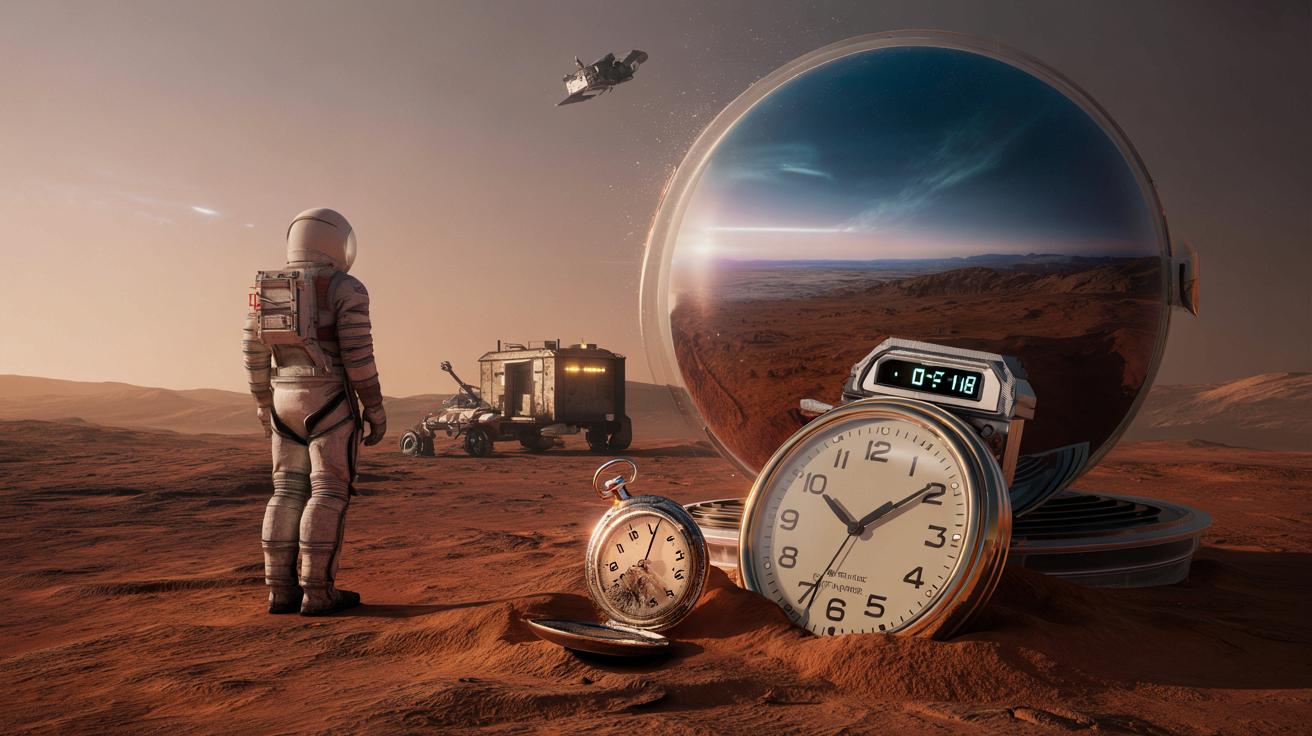
The first time you see a Martian sunset on a NASA feed, it feels oddly wrong. The sky bleeds a dusty blue near the horizon, the rocks glow red, and your brain quietly whispers: this isn’t how evenings are supposed to look.
Now imagine that while that strange twilight unfolds, a clock on Mars is silently falling out of sync with a clock on Earth. Tick by tick. Second by second. Day after day.
On paper, Einstein predicted this a century ago. In practice, Mars has just turned it from abstract theory into a logistical nightmare for future missions.
Because on the red planet, time doesn’t just feel different.
It actually flows differently.
When Einstein’s equations crash into Martian dust
At NASA’s Jet Propulsion Laboratory, mission planners have a phrase: “Mars time”.
It sounds like a joke, the kind of thing you say when a project runs late. But it’s not a joke at all. Mars literally runs on a different clock.
A Martian day, a “sol”, lasts about 24 hours, 39 minutes and 35 seconds. That alone already breaks our inner rhythm. Yet layered on top of that is Einstein’s twist: clocks in different gravitational fields and at different speeds don’t agree on how fast time passes. On Earth that’s a neat physics fact. On Mars, it’s starting to be a problem you can’t ignore.
Think of the Curiosity rover. When it landed in 2012, its team in California shifted their lives to follow the Martian day.
They went to work 40 minutes later every Earth day, so their schedule could track the rover’s local “morning” on Mars.
For a while, it was fun and strange. Then it became exhausting. People were grocery shopping at 3 a.m., eating dinner at sunrise, barely seeing family. That’s just from syncing to the longer Martian day. Now add relativistic time shifts from orbiting spacecraft, deep-space travel, and precision landing systems that depend on nanoseconds. The tiniest drift starts to matter.
Einstein’s general and special relativity both kick in here. Clocks closer to a massive object tick slightly slower. Clocks moving quickly tick slightly slower too. Earth is heavier, spins differently, and orbits at a different speed from Mars. So an atomic clock on a satellite around Mars will not keep perfect pace with one back home.
On GPS satellites around Earth, engineers already correct for relativity, or your navigation app would be off by kilometers. Mars is forcing the same kind of correction, but spread across planets, spacecraft, and future bases. Time is becoming a resource that needs active engineering, not just a number on a screen.
The new rulebook for timing missions between two worlds
So what changes when space agencies accept that Mars runs on its own tempo?
First, you need a common language of time that both planets can agree on, even if their clocks drift.
➡️ Excess rainfall could remake the Sahara and upset Africa’s fragile balance, study warns
➡️ Forget Burj Khalifa and Shanghai Tower: Saudi Arabia readies a 1km-tall skyscraper
Mission designers are quietly sketching out something like “Mars Coordinated Time” to sit alongside Earth’s UTC. The idea is simple: define a reference clock on Mars, probably tied to a network of orbiters and landers, then constantly compare it with ultra-stable clocks on Earth. Software will translate between the two. For pilots and astronauts, it might feel like time zones gone wild: “We’ll meet at 14:00 UTC / 13:22 MTC.”
The second step is more hands-on. Every mission will need built‑in time correction. Spacecraft already carry atomic clocks, but future ones will treat time like a system that can fail, not a neutral backdrop.
Picture a cargo ship headed for a future Mars base. Its route depends on precise navigation signals delayed by several minutes each way. If its onboard clock starts to drift due to relativistic effects, the predicted landing zone can shift by dozens of kilometers. So engineers will schedule regular “time health checks” with Earth, like medical checkups for the spacecraft’s sense of now. Let’s be honest: nobody really does this every single day with the discipline the manuals suggest, but as missions grow complex, they’ll have no choice.
There’s a human side to this timing revolution too. Astronauts on Mars will live on sols, while their families remain on Earth days. A birthday call might technically be “on time” on Mars and “late” on Earth. That sounds trivial until you imagine months of emotional micro-frictions stacking up in small crews under stress.
Some agencies are already training teams with rotating time schedules, simulating Martian days and communication delays. Psychologists watch how people react when their sense of shared time starts to fray. *Losing a common clock turns out to be surprisingly destabilizing.*
From the physics lab to the kitchen table of a Martian habitat, Einstein’s equations are suddenly in charge of daily life.
Living, working, and staying sane when time splits
For mission planners and future Mars crews, the first survival skill is simple: anchor yourself in one primary time frame.
You can juggle Earth time, Mars time, and spacecraft time on paper, but your body needs a single rhythm.
The most practical approach is to choose “local Mars time” as the daily backbone. Sleep, meals, EVA outings, and lab shifts all sync to the Martian sol. Then Earth-related tasks — calls with mission control, scheduled data dumps, family messages — are treated like appointments in another time zone. This is less glamorous than sci‑fi movies, but it’s how humans actually function without going quietly mad.
One common mistake is trying to live on both clocks at once. New staff on Mars analog missions often keep Earth habits: checking news “in the morning”, calling home at “evening”, sticking to old rituals. After a few weeks they feel permanently out of sync, as if jet-lagged but without the flight.
The more honest teams admit this upfront. They design dedicated “Earth windows” into the schedule, instead of constantly chasing overlapping hours. There’s also a risk for ground teams: obsessing over perfect relativistic corrections while forgetting the simple question, “Can the crew actually sleep and think on this timetable?” A mission can be mathematically flawless and psychologically doomed.
At the core of all this is a quiet cultural shift: time in space is no longer a background setting, it’s an engineering and human‑factors variable.
Future mission docs may read less like abstract physics and more like this: adjust orbital clock drift daily, log Mars–Earth offset hourly, and protect crew from schedule fragmentation at all costs.
- Define a clear primary time (usually local Mars time) for all human routines.
- Use software to translate between Earth, Mars, and spacecraft clocks, instead of doing mental math.
- Plan “contact windows” with Earth as events, not as the backbone of the day.
- Schedule regular clock syncs between Mars orbiters, landers, and Earth-based references.
- Train crews emotionally for drifting birthdays, anniversaries, and milestones across two different calendars.
When two civilizations no longer share the same second
Somewhere between Einstein’s chalkboard and a dusty rover wheel on Mars, time stopped being universal and started becoming local. That shift sounds philosophical, but it may define how we expand beyond Earth.
Once there are permanent bases on Mars, children could grow up counting their lives in sols, not days. A Martian might say they’re “15 Martian years old” and arrive “early” to a call that feels late to their Earth cousin. Contracts, broadcasts, live sports, shared online games — every cross‑planet event will juggle at least two definitions of now.
We’ve all been there, that moment when a simple time-zone mix‑up makes you miss an important call. Stretch that confusion across a hundred million kilometers and a different gravitational well, and you glimpse what’s coming.
The strange part is that Mars isn’t breaking physics. It’s revealing what was always true: time was never as absolute as we behaved. We just lived on one planet long enough to pretend it was.
| Key point | Detail | Value for the reader |
|---|---|---|
| Relativity is now operational | Einstein’s time dilation isn’t just theory; mission clocks on Earth, in transit, and on Mars must be corrected and synced | Helps you grasp why future space news will talk about timing systems as often as rockets |
| Mars will need its own time standard | Concepts like “Mars Coordinated Time” will structure daily life, from rover commands to astronaut sleep cycles | Makes distant concepts like planetary time zones concrete and relatable |
| Human rhythms matter as much as equations | Living on a 24h39m sol with Earth-based communication windows creates stress if poorly designed | Shows how big science decisions ultimately hit real people, families, and routines |
FAQ:
- Question 1Does time really flow differently on Mars, or is it just the longer day?
- Answer 1
Time differs in two ways. First, the Martian “sol” is longer than an Earth day, so daily rhythms shift. Second, relativity says clocks in different gravitational fields and motions tick at slightly different rates. So an identical high‑precision clock on Mars will not stay perfectly in sync with one on Earth over long periods.
- Question 2Is the relativistic time difference between Earth and Mars big enough to matter?
- Answer 2
On a human scale, you wouldn’t feel it — we’re talking microseconds to milliseconds over long durations. For navigation, landing accuracy, and coordination between multiple spacecraft and habitats, that small drift matters a lot. It’s similar to GPS satellites around Earth: if you ignore relativity, your position fixes go wildly off.
- Question 3Will astronauts on Mars use Earth clocks or a completely new system?
- Answer 3
They’ll probably use both. Daily life will sync to a local Martian clock tied to the sol, while mission control and international coordination will still reference Earth’s UTC. Software and mission tools will automatically convert between them, a bit like handling multiple time zones today — just with more physics behind it.
- Question 4Could living on Mars change how people age in comparison with Earth?
- Answer 4
Biologically, you’ll age the same way — diet, radiation, and healthcare will matter far more than relativity. From a pure physics standpoint, a person living their whole life on Mars would accumulate a tiny difference in elapsed time compared with a twin on Earth, but the gap would be too small to notice outside very precise measurements.
- Question 5Why are scientists talking about “Mars Coordinated Time” already if no one lives there yet?
- Answer 5
Because timing is one of those things that gets messy fast if you improvise later. As more orbiters, landers, and eventual habitats share data, they need a common reference. Designing a robust Martian time standard now will avoid costly confusion and help future missions plug into a stable, predictable temporal framework from day one.