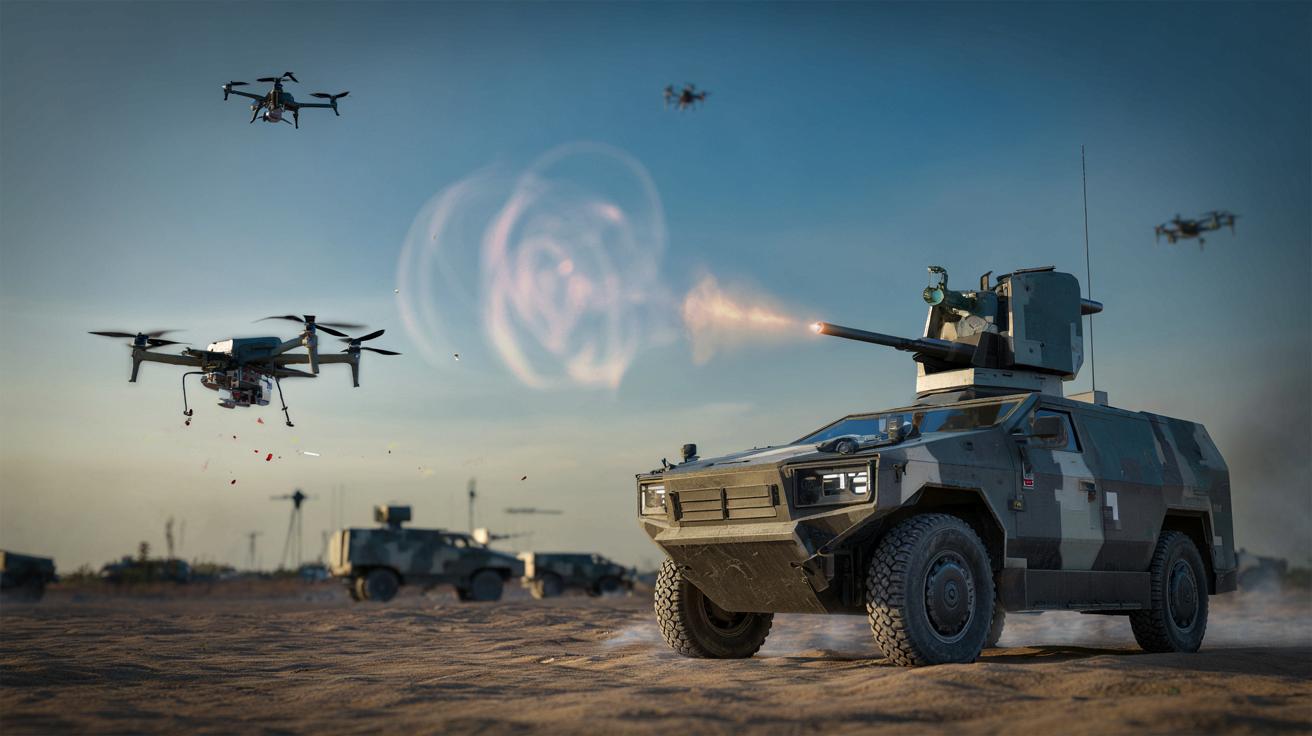
On a dusty training ground in northern China, a boxy armored vehicle rolls forward, oddly quiet. No turret, no cannon silhouette. Just a swiveling cluster of lenses and a squat, futuristic barrel that looks more like a piece of lab equipment than a weapon. Above it, the sky hums with the faint, mosquito-like buzz of small drones — the same cheap quadcopters that have redefined war in Ukraine and the Middle East. The vehicle stops, the turret snaps upward, and a thin, invisible burst of energy cuts the air. One drone jerks, then simply drops, as if someone just pressed “off” on gravity.
No smoke. No explosion. Just a silent kill.
Somewhere in Brussels and Washington, people are watching that same scene on repeat.
China’s wheeled “drone killer” crashes into the global spotlight
The new Chinese system, spotted at a recent defense expo and quickly dissected by analysts on social media, looks like the answer to a problem every army now dreads: skies filled with hostile drones. Mounted on a wheeled armored chassis, this “drone killer” blends the mobility of an infantry vehicle with the precision of high-tech sensors and directed-energy weapons. It’s the kind of machine designed not to shock with size, but with cold efficiency.
The message behind it is crystal clear. China wants to show that it can not only launch swarms of drones, but also neutralize them with a purpose-built platform that seems tailored for the wars we’re already watching on our phones.
Footage of the vehicle circulated first on Chinese state TV, then bounced across X and Telegram channels that obsess over military hardware. Analysts quickly picked out familiar elements: electro-optical sights, radar panels, and what looks like a high-energy laser or powerful electronic jammer on the roof. Some unofficial specs talk about engagement ranges of a few kilometers for small drones and the ability to track multiple aerial targets at once.
None of that is fully confirmed, of course. Beijing rarely publishes detailed capabilities. But the visuals alone are enough to trigger concern. For NATO planners, this isn’t just a new toy on wheels. It’s a signal that China is racing ahead in the cat-and-mouse game of drone warfare, where the side that adapts fastest tends to dictate the tempo on the battlefield.
Why does this matter so much to Europe and the United States? Because every recent conflict has turned into a laboratory for drones — and for the systems meant to stop them. From cheap FPV kamikaze drones in Ukraine to loitering munitions in the Red Sea, the airspace just above ground level has become the most chaotic part of the modern battlefield. Traditional air defenses, built to intercept jets or ballistic missiles, struggle with swarms of tiny, low-flying targets that cost a few hundred dollars.
A purpose-built, wheeled anti-drone platform suggests that China is designing from scratch for that new reality. And if Beijing can deploy these vehicles in numbers, it doesn’t just protect its own troops. It starts exporting a turnkey “anti-drone shield” to partners and clients — reshaping the global balance of power one contract at a time.
Why this vehicle hits a nerve in Europe and the United States
On paper, Western countries also have anti-drone systems. The US has Stryker vehicles fitted with lasers, electronic warfare pods, and short-range missiles. European companies are fielding truck-mounted jammers and radar-guided guns. But there’s a gap between glossy brochures and what’s actually rolling down muddy roads in frontline conditions. Many of these Western solutions are still in trials, deployed in limited numbers, or stitched together in a hurry.
➡️ Disbelief in zoology: the first offspring of a protected animal is born in the wild after 100 years
China’s wheeled drone killer lands at a moment when European armies are publicly admitting they’re behind the curve. The contrast is uncomfortable, and that’s exactly why this vehicle makes so many people nervous.
Take Ukraine as a living case study. Ukrainian units often improvise: mounting anti-drone jammers on pickups, welding cages on tanks, taping commercial antennas to aging Soviet vehicles. American and European donations help — systems like Germany’s Skynex or the US-made VAMPIRE kits — but they arrive gradually, in limited batches, and usually after months of political debate.
Now imagine a country that can design, produce, and field a standardized wheeled anti-drone vehicle at industrial scale. No crowdfunding. No duct tape. Just a platform that is mass-produced, doctrinally integrated, and exported to allies from Pakistan to the Middle East, or even to states in Africa hungry for turnkey tech. That’s the strategic picture behind that short clip from a Chinese test range.
There’s a more uncomfortable layer to this story. Western militaries spent decades optimizing for big-ticket airpower: stealth fighters, cruise missiles, integrated air defense networks tuned to spot fast, high-altitude threats. The swarm of cheap drones arriving low and slow felt, at first, like an annoyance rather than an existential risk. By the time that attitude shifted, battlefield reality had already changed.
China, watching every video from Ukraine as closely as any NATO analyst, appears to have skipped that denial phase. Building a **wheeled, mobile, specialized “drone killer”** looks like a direct response to what modern war actually looks like, not what powerpoints predicted fifteen years ago. Let’s be honest: nobody really redesigns entire doctrines until they’re forced to.
How this “drone killer” actually fights — and where the West stumbles
Strip away the patriotic slogans and slick CGI, and the basic method is relatively simple. The vehicle combines three key tools: detection, tracking, and neutralization. First, a compact radar and optical sensors scan for small objects in the low sky. Then software filters birds, debris, and friendly drones from hostile ones. Finally, the system fires — either with a high-energy laser that burns or blinds the drone’s sensors, or with a powerful electromagnetic pulse that fries its electronics, or with concentrated jamming that severs its control link.
None of this is magic. It’s the tight integration, on a wheeled, protected chassis, that turns it into a battlefield tool instead of a science-fair project.
This is where Western efforts often stumble. Many anti-drone setups are “add-ons”: a jammer bolted to a vehicle never designed to carry it; a radar talking awkwardly to a command system from another era; software patched together from multiple vendors that don’t always play nicely. Soldiers complain about heavy batteries, clunky interfaces, limited ranges, and systems that work great at demo day but struggle in rain, dust, or electronic clutter.
We’ve all been there, that moment when a shiny new piece of tech turns out to be a headache rather than a help. For front-line troops, a tool that is 80% effective but simple, rugged, and always-on is often better than a 99% theoretical solution that needs a small IT department to keep it running.
European and US officers who spoke off the record in recent months often say the same thing: they need fewer scattered gadgets and more integrated platforms. As one retired NATO air-defense specialist put it:
“Drones have democratized airpower. If we don’t democratize air defense with systems that are mobile, affordable, and easy to train on, we’re just repeating the mistakes of the last decade — but faster.”
In practice, that means a few clear priorities:
- Bring sensors, jammers, and kinetic weapons onto unified, mobile platforms.
- Cut training time so conscripts can operate anti-drone gear within weeks, not months.
- Design for mass production, not just boutique “gold-plated” systems.
- Think in layers: handheld jammers, vehicle-mounted platforms, and higher-level radar nets.
- Accept that cheap, “good enough” defenses will matter as much as flagship laser projects.
What this says about tomorrow’s wars — and our role in them
Behind the tech specs and scary headlines, the Chinese wheeled drone killer forces a blunt question: who will control the low sky? The quiet band of airspace between treetops and rooftops is becoming as contested as any shipping lane or oil route. In that band, a thousand-dollar quadcopter and a million-dollar missile can suddenly end up in the same frame — and the cheaper object doesn’t always lose.
For Europe and the United States, the rise of purpose-built anti-drone vehicles is a wake-up call that goes beyond budgets. It touches doctrine, training, industry, and even public perception. Citizens who once imagined war as distant jets and satellite-guided bombs now watch TikToks of drones dropping grenades through open hatches. The battlefield has moved closer to everyday technology — and to us.
*The plain truth is that whoever adapts fastest to this new normal will shape not just future wars, but the rules and red lines around them.* Will Western democracies accept a world where cheap drones and their equally flexible countermeasures are exported freely? Will alliances like NATO turn anti-drone defense into a shared, standardized priority, or let each country improvise alone? Those questions won’t be answered by one Chinese vehicle on a test track, but that boxy machine on wheels has quietly pushed them to the front of the agenda.
| Key point | Detail | Value for the reader |
|---|---|---|
| China’s wheeled drone killer is purpose-built | Integrated sensors, jamming or laser systems, and armor on a mobile chassis | Helps you understand why this vehicle is more than just another prototype in a parade |
| West is scrambling to catch up | US and European systems exist, but are often fragmented, few in number, or improvised | Offers context for the growing alarm in Brussels and Washington |
| The low sky is the new strategic frontier | Drones and anti-drone tools are reshaping how wars are fought and funded | Shows how this tech race could influence security, politics, and daily life in the coming years |
FAQ:
- Is China really ahead of the West in anti-drone vehicles?Not across the board, but this wheeled drone killer shows Beijing is moving fast on integrated, mobile platforms, while many Western systems are still scattered or in limited deployment.
- Does this vehicle actually use a laser to shoot down drones?Officially, China hasn’t confirmed the exact weapon, yet imagery and state media hints suggest a mix of high-energy laser or powerful electronic warfare tools focused on disabling drones’ electronics.
- Why are Europe and the US so worried about one vehicle?Because it symbolizes a broader shift: mass-producible, specialized anti-drone tools that can be exported widely, altering regional balances of power far from China’s borders.
- Can traditional air defenses handle drone swarms?They struggle, especially against cheap, low-flying quadcopters; systems built for jets and missiles are too expensive and not optimized for the sheer volume and small size of modern drones.
- What comes next in the drone vs. anti-drone race?Expect more AI-driven targeting, cheaper jammers, compact lasers, and layered defenses — from shoulder-fired systems to armored vehicles dedicated to patrolling the low sky.