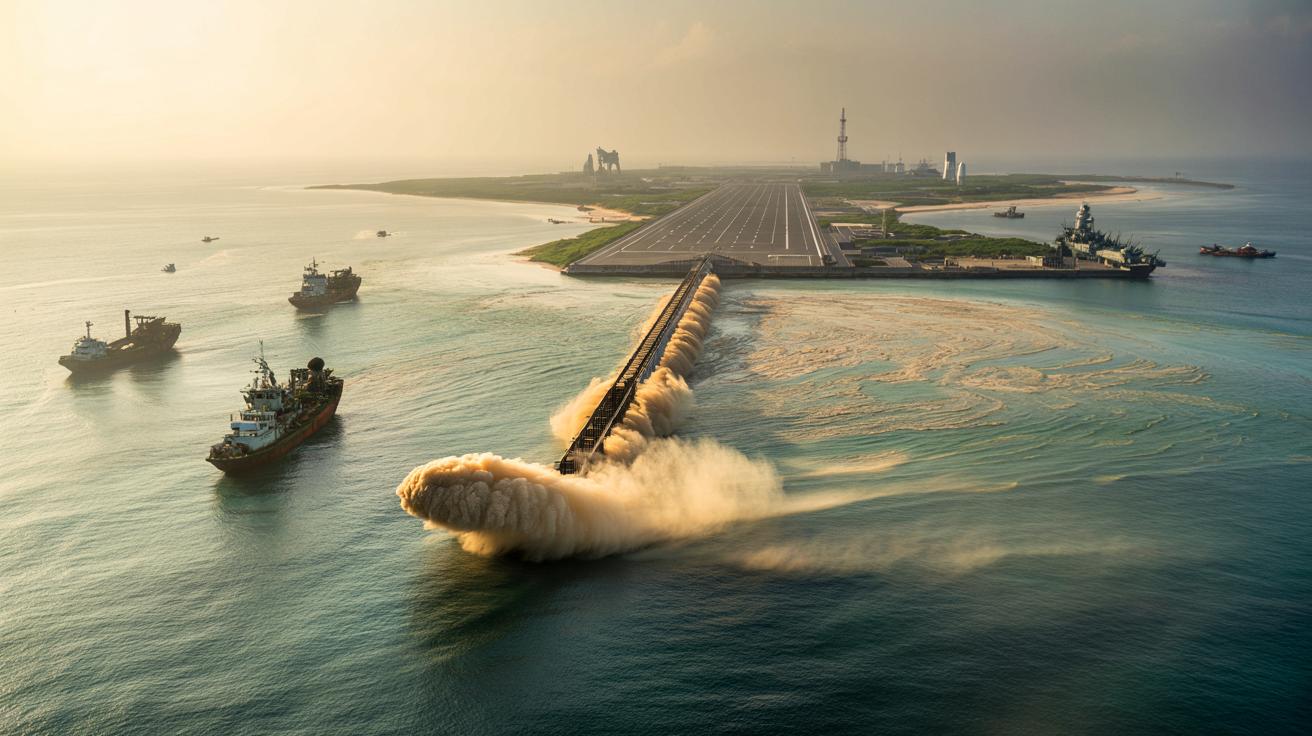
The sea looks calm until you notice the ships. Not fishermen, not cargo giants, but long, low dredgers sliding across the water like slow-moving factories. Their pipes spew a steady plume of pale sand into the waves, turning blue into beige, ocean into slurry. From the deck of a passing boat, it feels like watching someone repaint the map in real time.
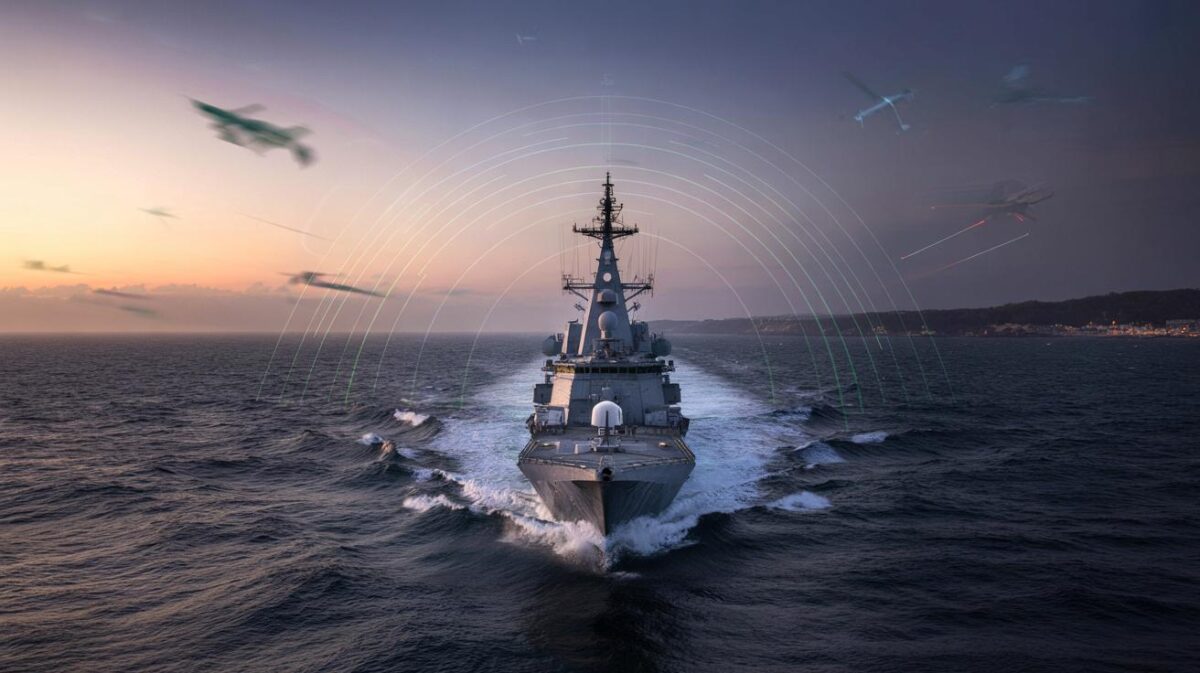
A few years ago there was nothing here but open water and coral. Today, runways gleam in the sun, radar domes sit like white golf balls on artificial hills, and military jets roll across land that simply did not exist before.
The strangest part? It all started with sand.
How China turned empty water into hard land
On satellite images from the early 2010s, the Spratly Islands look like tiny freckles in a vast blue face. By the late 2010s, those freckles have grown into pale green fists, each ringed by turquoise lagoons and sharp grey runways. The time-lapse is mesmerizing and a little unsettling.
What you’re really seeing is China’s quiet, relentless experiment: building islands from scratch by dumping countless tonnes of sand and crushed coral onto shallow reefs. The process is almost brutally simple. Find a reef, park a dredger, and start pumping the seabed onto the surface until a new coastline appears above the waves.
Between roughly 2013 and 2016, Chinese dredgers worked day and night across the South China Sea. US officials estimate that **more than 3,000 acres of new land** were created in just a few years on reefs like Fiery Cross, Subi, and Mischief. That’s roughly the size of a small city, conjured from saltwater and sediment.
Fishermen from the Philippines and Vietnam tell the same kind of story. They left home one season passing half-submerged reefs they’d fished for years. They came back months later to concrete piers, radar towers, and soldiers waving them away with loudspeakers. The sea they thought they knew had been edited while they were gone.
The basic technique is called land reclamation. Dredgers suck up sand from the seabed or nearby shoals, then spray or pipe it onto a reef, layer after layer. Bulldozers and rollers compact the slurry until it begins to behave like solid ground. Engineers then cover it with rock, concrete, and reinforced foundations so it doesn’t simply wash away in the first big storm.
On paper, it’s engineering. On the water, it’s power. By turning scattered reefs into permanent, fortified islands, Beijing has been able to extend runways, station aircraft, place missile systems, and project its presence deep into a disputed sea. *This is cartography done with engines and steel, not with pens and treaties.*
The hidden costs under the waves
For all the hard lines on new maps, the first victims of this artificial land are soft and silent. Coral reefs don’t just “move aside” when dredgers arrive. They’re ground, buried, and smothered. Marine biologists who’ve studied the region say entire reef systems that took thousands of years to form have been damaged in a matter of months.
➡️ France and the Rafale lose a €3.2 billion deal after last?minute U?turn
➡️ Adopt a German Shepherd Dog Rescue Dog Lila « loving homes needed urgently »
The sand curtains thrown up by constant dredging travel far beyond the work zone. They cloud the water, block sunlight, and choke coral polyps and seagrass beds. Fish that depended on the reef for food or shelter simply… vanish from the area.
Around Mischief Reef, Filipino fishers describe once-busy fishing grounds turning eerily quiet. Where there were schools of grouper and snapper, there are now silted bottoms and shiny new piers guarded by patrol boats. One captain recalled the first time he saw the huge dredgers on the horizon: “We thought it was just some construction. Next year there was a whole island where we used to drop our nets.”
Scientists who’ve tagged and tracked species like giant clams and reef fish in the South China Sea have reported broken migration routes and collapsed spawning sites. An underwater maze of color and life has been swapped for flat, hard land, perimeter walls, and fuel tanks.
There’s also the question nobody can escape: what happens when the storms hit harder? Artificial islands sit on shifting foundations. They’re exposed to typhoons that tear through the region with increasing force. Engineers reinforce them with sea walls and concrete blocks, but the surrounding reefs, which naturally soften wave energy, are already damaged or gone.
At the same time, sea-level rise creeps upward millimeter by millimeter. Countries can pile sand high and draw straight lines on new maps, yet the ocean doesn’t care about political ambition. Let’s be honest: nobody really controls water in the long run.
From a distance, these islands look like triumphs of human will. Up close, they also look like bets placed against a changing climate.
Geopolitics written in sand
There is a method to this sandy madness. Under the UN Convention on the Law of the Sea, natural islands can generate territorial waters and exclusive economic zones. Artificial islands, strictly speaking, don’t. That’s where the tension starts.
China claims historical rights over vast stretches of the South China Sea, overlapping with the claims of the Philippines, Vietnam, Malaysia, Brunei, and Taiwan. By turning low-tide features and reefs into 24/7, concrete-topped outposts, Beijing reinforces a physical presence even where lawyers and diplomats fiercely disagree.
Other countries have done land reclamation too, from Singapore expanding its coast to Dubai building palm-shaped peninsulas. The scale and location of what China has done are different. These are not tourist resorts on home shores; they are fortified positions in contested waters threaded with some of the world’s busiest shipping lanes.
We’ve all been there, that moment when a line that used to be fuzzy suddenly becomes very clear. For neighboring states, the new Chinese-built islands are that line. They change how coast guards patrol, where fishermen dare to sail, and how close foreign navies come to those artificial runways.
In Washington, Tokyo, and Canberra, maps of the South China Sea now hang in military planning rooms with red circles drawn not around old reefs but around new airstrips and radar sites. US warships conduct “freedom of navigation” operations, sailing within 12 nautical miles of some of these man-made islands to signal they don’t recognize them as legitimate territory.
Beijing answers with radio warnings and its own patrols. The result is a constant, humming tension in a sea that carries trillions of dollars of trade every year. One plain-truth sentence sits beneath it all: **new sand has made old disputes much harder to ignore.**
Decision-makers know the technical detail: artificial islands don’t magically create new legal rights. On paper, Mischief Reef stayed a low-tide elevation no matter how many runways were built on top. Yet politics rarely lives only on paper. Once a structure exists, once troops are stationed, once flags are raised and roads laid out, the debate shifts from “who owns the reef?” to “who’s willing to challenge the base?”.
In that subtle legal gap, China has found room to maneuver. By the time lawyers finish arguing, the concrete is already dry.
What this means for the rest of us
You might be thousands of kilometers away from the South China Sea, far from any dredger or coral reef. Still, what’s happening there quietly touches your everyday life. The shipping lanes that snake through these waters carry fuel, food, and phones. If tensions spike, so do insurance costs, delivery times, and prices on the shelves.
There’s also a wider lesson in how fast the physical world can be reshaped when a state really wants something. Twelve years ago, those new islands were dots on a blueprint. Today, they’re hard reality.
For ordinary people in coastal regions worldwide, China’s project is a kind of preview. Other governments watch and take notes: how far can you go with land reclamation before the world really pushes back? What environmental price are you willing to pay to gain a strategic advantage or a bit more dry land for ports and airports?
The risk is a quiet copy‑paste effect. One country normalizes something that once seemed extreme; others follow, often with fewer safeguards and less engineering expertise. The ocean becomes a construction site punctuated with cranes and contested lines.
One Chinese engineer, speaking anonymously to a foreign reporter, put it bluntly:
“We used dredgers the way others use pens. Every day we drew more land onto the sea. Some of us were proud. Some of us were scared. The ocean used to feel infinite. Suddenly it felt… editable.”
That word — editable — hangs over the future.
- New islands show what intense political will can achieve, fast.
- They remind us that the sea is no longer a pure frontier; it’s becoming infrastructure.
- They force a uncomfortable question: just because we can build land, should we?
A new kind of coastline, and a new kind of question
Stand on one of these artificial islands, and the scene is both ordinary and surreal. There’s the smell of jet fuel, the thud of construction, the glare of fresh tarmac. There are workers scrolling through their phones on a lunch break. Beyond the seawall, turquoise water hits the concrete in small, regular waves, as if testing the edges of this new reality.
From certain angles, it feels like any remote airbase. From others, like a science-fiction set where humanity has started modding the planet in high definition.
For coastal cities squeezed by rising seas and crowded shorelines, the temptation to build outwards will keep growing. Engineers will promise smarter reclamation, softer footprints, “eco-islands” designed to blend with currents and reefs. Some of that may be real progress. Some of it will be pure branding wrapped around the same old hunger for space and leverage.
What China has done over 12 dense years in the South China Sea is a kind of stress test of our era: how quickly we can redraw geography, how fiercely we contest it, and how slowly we count the cost under the waves.
The next time you look at a map on your phone, remember that not all those shapes are ancient. Some were poured in place, barge by barge, pipe by pipe. The boundaries that feel so fixed can, under enough pressure and sand, move.
Whether that thought excites or worries you says a lot about the kind of future you expect to live in.
| Key point | Detail | Value for the reader |
|---|---|---|
| China’s artificial islands are built with sand dredged from the seabed | Dredgers pump sand onto reefs, which is then compacted and reinforced into usable land | Helps you grasp the very concrete, physical process behind a seemingly abstract geopolitical shift |
| The projects damage reefs and reshape local ecosystems | Coral is buried, water is clouded with sediment, and traditional fishing grounds are disrupted | Shows the hidden environmental cost behind the impressive images of new islands |
| New land changes power dynamics, not just coastlines | Runways, radars, and bases extend China’s reach into key shipping lanes and disputed zones | Connects a distant maritime dispute to trade, prices, and security in everyday life |
FAQ:
- Question 1How exactly does China build these artificial islands?By using large dredging ships to suck sand and sediment from the seabed and pump it onto shallow reefs. The sand is piled up, compacted, covered with rock and concrete, then topped with infrastructure like runways, ports, and buildings.
- Question 2Are these new islands legally recognized as Chinese territory?Legally, artificial islands don’t create new territorial seas under international law, and many countries reject China’s claims. Beijing, though, uses them to assert de facto control and keep a constant physical presence in disputed areas.
- Question 3How much land has China created in the South China Sea?Estimates point to roughly 3,000 acres of new land over the past decade or so, mainly on features like Fiery Cross Reef, Subi Reef, and Mischief Reef, which now host runways, harbors, and military facilities.
- Question 4What are the environmental impacts of this land reclamation?Coral reefs are destroyed or buried, water clarity drops from sediment plumes, fish habitats disappear, and traditional fishing zones are disrupted. These changes can be long-lasting and hard to reverse.
- Question 5Could other countries copy this strategy on a large scale?Some already use land reclamation for ports or housing, but matching China’s pace and scale in such a sensitive, contested sea would be difficult and risky. The more countries try, the more crowded and unstable key waterways could become.