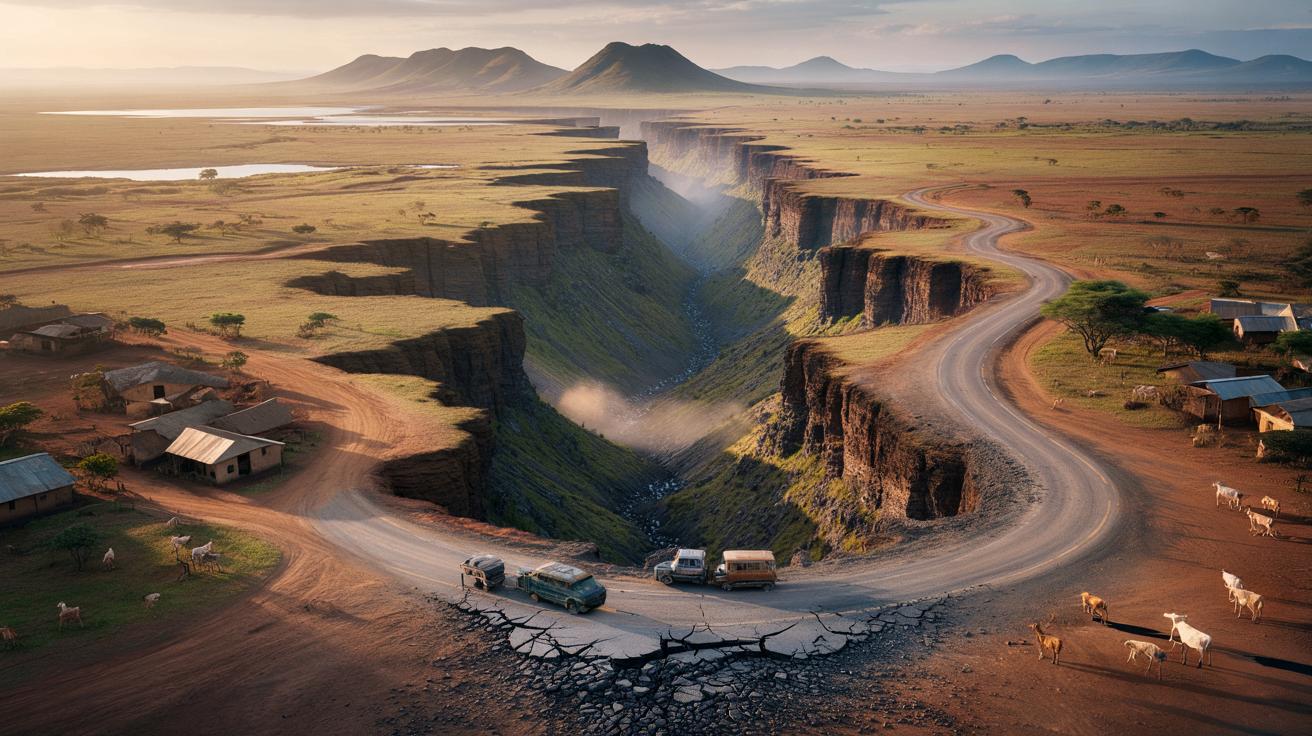
The taxi windows shook with every pothole as we drove across the dusty plains of Kenya. On one side of the road, goats and kids were playing in front of tin-roof houses. On the other side, the land suddenly dropped away into a long, jagged scar in the earth that seemed to go on forever. The driver slowed down without a word. You could literally see the ground tearing open.
A few meters away, a farmer pointed at the crack and laughed nervously for a TV crew. “They say a sea will pass here one day,” he said. His voice tried to sound casual, but his eyes were somewhere else.
A new ocean, right where his fields stand now.
It sounds like science fiction. Yet the cameras are rolling.
Africa is tearing open in slow motion
If you zoomed out far enough, Africa would look like a giant loaf of bread slowly cracking down the middle. From Ethiopia in the north to Mozambique in the south, a 3,000-kilometer scar known as the East African Rift is stretching the continent apart millimeter by millimeter. It’s not visible everywhere, of course. Most days, life moves on. People go to work, cook dinner, argue about football.
Then, once in a while, the planet reminds everyone who’s in charge. The ground moves. A wall splits. A highway bends just enough for the cameras to come. *Geology, caught live and trending.*
In 2018, a dramatic video from southwest Kenya went viral: a crack up to 15 meters deep and 20 meters wide suddenly appeared in a field near Mai Mahiu. A section of road collapsed. Families were evacuated. Cars balanced on the edge like toys. It looked like the opening scene of a disaster movie, but this was real life, filmed on shaky smartphones and posted straight to social media.
Scientists rushed in to explain that the crack wasn’t the start of the “end of Africa overnight,” but a snapshot of a process that’s been going on for tens of millions of years. The fissure followed older, weakened zones underground, carved over time by tectonic forces. The viral clip simply gave that invisible tension a face.
What’s actually happening beneath those viral images is slow, cold, mechanical. The African tectonic plate is being stretched by forces deep in the mantle. In the east, a new microplate — the Somali plate — is gradually separating from the larger Nubian plate. GPS stations placed across East Africa track the motion: a few millimeters of movement per year, about as fast as your fingernails grow.
Multiply those millimeters by a million years and you get something bigger than any map you’ve ever seen. *Given enough time, the crack will fill with water and form an entirely new ocean basin.* This process is how the Atlantic itself began.
➡️ Bad news for homeowners: starting March 15, a new rule bans lawn mowing between noon and 4 p.m.
➡️ Day Will Turn To Night With The Longest Total Solar Eclipse Of The Century
➡️ Bad news : a new rule prohibits mowing lawns between noon and 4 p.m. in 23 departments
The new ocean scientists say is coming
So what will this “new ocean” actually look like? Picture the Red Sea first. Long, narrow, framed by high scarps on both sides. Now imagine something like that, stretching through Ethiopia, Kenya, Tanzania, and Mozambique, opening wider over millions of years. This is the vision many geologists sketch when they talk about the future Africa: split into two huge landmasses with a fresh ocean in between.
The process usually starts with rift valleys filled by lakes, like Lake Turkana or Lake Tanganyika. Then volcanic activity thins the crust. Hot mantle rises. Eventually, the crust tears fully and seawater invades. It’s not magic. It’s physics.
People living in the Rift Valley already see hints of this water future. Lakes are rising and swallowing houses along their shores in Kenya. In Ethiopia, you have chains of deep lakes aligned like beads along the rift. Some of them rest on actively thinning crust. Along parts of the Afar region, the boundary between land and sea is already blurred: salty plains, young lava, and the nearby Red Sea pushing in.
When satellites watch this region, they capture tiny shifts after earthquakes or eruptions. In 2005, for instance, a 60-kilometer-long crack in Ethiopia opened in a matter of days during a dramatic rifting event. Scientists flew in with drones and instruments as if they were watching a new tectonic corridor being born in real time.
Geologists say that, on the scale of Earth history, the East African Rift is in a “teenage phase.” Not as young as a simple crack, not yet a mature ocean. The crust is thinning, volcanoes are aligned along the rift, and magma intrudes under the surface more often. Seismic waves tell researchers where the mantle is rising, feeding this slow separation.
Let’s be honest: nobody really thinks about plate tectonics when they’re stuck in traffic. Yet these same forces silently set up the disasters and landscapes our grandchildren will inherit. When scientists talk about a new ocean forming in 5 to 50 million years, they’re not predicting tomorrow’s news. They’re reading a pattern that has already shaped the Atlantic, the Indian Ocean, the Gulf of Aden — and is now at work beneath African feet.
The evidence and the viral videos, without the panic
When you watch those dramatic YouTube clips of “Africa splitting apart,” the temptation is to think everything is happening at once. One crack, one storm, one night — boom, a new coastline. That’s not how this works. The best way to read these images is like chapters in a very long book. Each video shows a local response to regional forces that have been building for ages.
If you want to understand them better, start with three lenses: location, timescale, and cause. Where is the footage taken? Over what timeframe did the ground actually move? What do local geologists say caused that specific crack or sinkhole? Suddenly, the drama becomes a bit clearer, and strangely, more fascinating.
There’s also a very human side to this story that’s easy to miss while chasing clicks. Those cracks in Kenya? They’re tearing through people’s farms, grazing lands, and sometimes homes. Families wake up and find a trench where they used to plant maize. Children walk to school past newly drawn fault lines. You can’t just shrug and say, “Well, that’s plate tectonics for you.”
Scientists are trying to balance global curiosity with local reality. They warn against blaming every crack on “Africa splitting in two,” because some are linked to heavy rain, erosion, or poorly built roads. Others are indeed aligned with deeper faults. Both truths can exist in the same landscape.
“Rifting is a slow process punctuated by sudden, spectacular events,” explains one East African geophysicist. “The videos show the fireworks, but not the long, quiet burn beneath.”
To read those fireworks more calmly, it helps to keep a simple checklist in mind:
- Check the source of the video – Local news, scientific teams, and geological surveys usually give clearer context than random reposts.
- Look for mentions of known rift zones – Places like Afar, the Kenyan Rift, or the Main Ethiopian Rift are key hot spots.
- Ask what happened before and after – Was there heavy rain? Seismic activity? Previous ground subsidence in the area?
- Remember the timescale – The continent is moving, yes, but on human lifetimes, the risk is more about local hazards than a sudden “new ocean” opening overnight.
Living on a continent that’s slowly changing shape
When you pull back from the headlines, the deeper question is almost philosophical. What does it mean to live on land that is quietly rearranging itself under your feet? For many East Africans, the answer is oddly practical. You adapt to frequent tremors, occasional eruptions, rising lakes, and shifting roads. You respect the rift like you respect the weather: you don’t control it, you work around it.
The story of Africa’s future ocean is not just one of danger, but of possibility. Rift zones can bring fertile soils, geothermal energy, rich mineral deposits, and new scientific knowledge. They also bring uncertainty, yes, and forced migration in some cases. Two truths again, intertwined like the strands of a fault line.
Somewhere in the far future, maps may show a long blue tongue of ocean where today we see savannah and highland farms. The Nubian and Somali plates will stand as separate continents, with ports where now there are villages and reefs where now there are roads. Nobody alive today will see that world, and yet our cameras are already documenting its birth. That strange gap between human time and geological time is part of what makes these viral images so haunting.
We’ve all been there, that moment when a piece of news makes you feel suddenly small, like an extra in a planet-sized story. This is one of those stories.
| Key point | Detail | Value for the reader |
|---|---|---|
| East African Rift is real and active | A 3,000 km fracture zone stretching from Ethiopia to Mozambique, where the African plate is slowly splitting | Helps you separate science from clickbait when you see dramatic “Africa cracking” headlines |
| A new ocean could eventually form | Over tens of millions of years, thinning crust may tear fully, letting seawater flood in between two future landmasses | Offers a long-term perspective on how continents and oceans are constantly reshaping |
| Viral videos are snapshots, not the whole story | Local cracks often mix everyday erosion with deep tectonic forces, and need careful interpretation | Gives you practical questions to ask before sharing or believing sensational footage |
FAQ:
- Is Africa really splitting into two continents?Yes, the East African Rift shows that the eastern part of Africa (the Somali plate) is slowly moving away from the rest (the Nubian plate). The motion is very slow, a few millimeters per year, but geologically speaking, this is the early stage of a continental breakup.
- Will a new ocean really form in the rift?Current models and comparisons with past rifts suggest that, if the process continues, the rift could eventually open into a new ocean basin, similar to how the Red Sea and Atlantic Ocean began. This would likely take tens of millions of years.
- Are the huge cracks in Kenya proof that the continent is tearing now?They are visible signs of ground movement in a rift zone, but many of them are also influenced by heavy rainfall, erosion, and existing weak layers in the ground. They fit into the broader rift story, yet they don’t mean the continent is about to snap in our lifetime.
- Is it dangerous to live near the East African Rift?There are real risks: earthquakes, volcanic eruptions, land subsidence, and rising lakes. Millions of people already live with these hazards, much like people elsewhere live with hurricanes or typhoons. Local building codes, monitoring, and preparedness matter a lot.
- Can scientists predict exactly when the ocean will appear?No. They can estimate stages of rifting using GPS, seismic data, and rock studies, but exact timing is impossible. The “new ocean” is a concept grounded in strong evidence, yet the details of when and how fast remain part of an unfolding experiment written in rock and time.