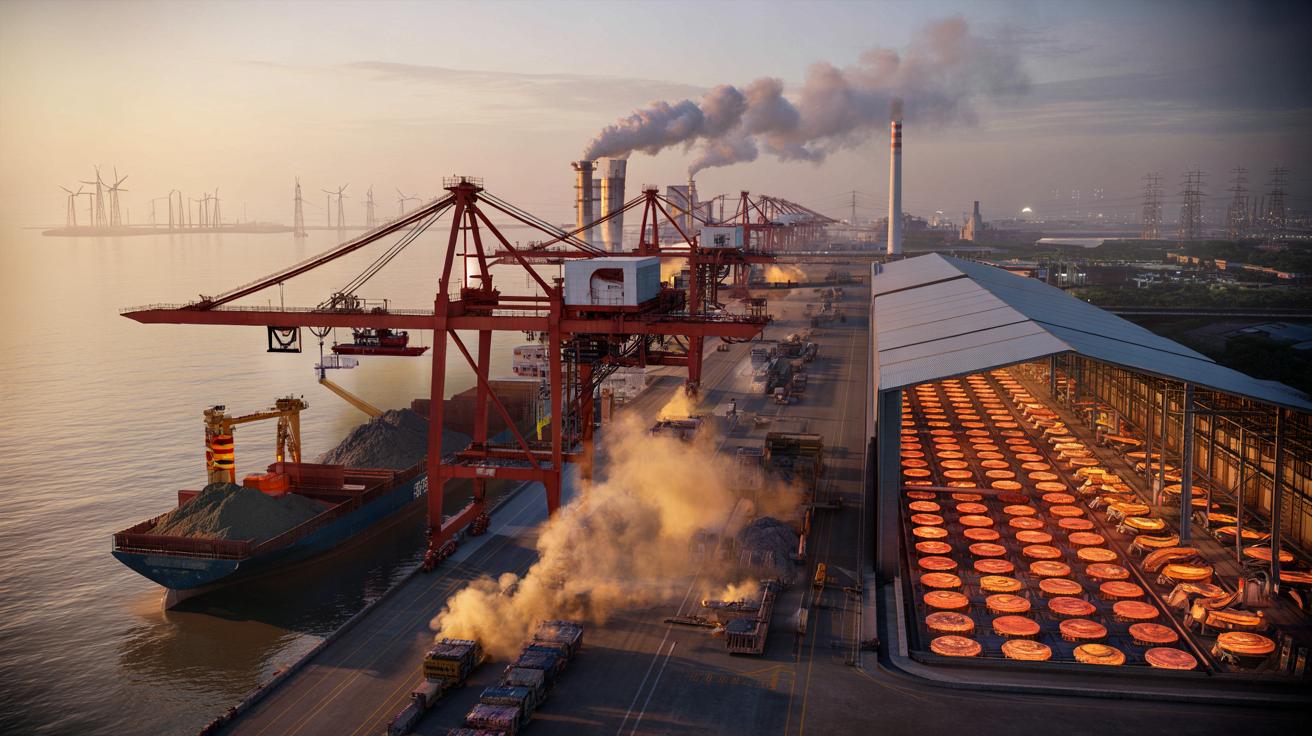
At the port of Lianyungang, huge red cranes move in slow, heavy arcs, unloading dull, grayish rocks from ships that have crossed half the world. No one on the nearby road really pays attention. The trucks pull away, the dust hangs in the air for a second, and that’s it — just another anonymous cargo in a country that has seen thousands.
Those rocks are copper concentrates from Chile, Peru, the Congo. And most of them will leave China again in a different form: bright, pure copper cathodes that end up in wind farms in Texas, power lines in Germany, data centers in Ireland.
The world talks a lot about Chinese dominance in rare earths.
Almost nobody talks about what’s quietly happening with copper.
China’s other quiet monopoly: turning rock into copper
Go back a decade and copper felt like a straightforward story. Mines in Latin America and Africa exported ore, traders moved it around, consumers in Europe, the US and Asia bought the metal for wires, motors and pipes. A global commodity, multiple players, no obvious puppet master.
Then Chinese smelters and refineries started to grow like cities in time-lapse videos. New plants in Shandong, Guangdong, Guangxi. Old ones expanded. Environmental rules tightened in the West while permits dragged on. Capital, power and political will began to concentrate in one place.
Today, a quiet shift has happened right under the radar.
Walk through a coastal Chinese copper smelter zone and you see the whole chain in motion. High-sulfur concentrate from Peru goes into one gate, blister copper and refined cathodes come out the other. The sulfur becomes acid for fertilizer, the heat is reused for district power, the byproducts feed battery and chemical plants next door.
It’s messy, noisy, and relentlessly efficient. While Western debates dragged on over whether to build or expand smelters, China just kept pouring concrete. According to industry estimates, China now handles roughly **half to two‑thirds of the world’s copper refining capacity**, even though it controls a much smaller share of mining.
The ore comes from everywhere. The value-add sits in one country.
➡️ Birdwatchers say this one winter fruit keeps robins loyal to your garden
There’s a simple economic logic behind this. Smelting and refining copper need cheap electricity, large upfront investment and the ability to live with heavy industry in your backyard. Many rich countries outsourced that dirty middle step, happy to import cleaner, nicely shaped copper cathodes instead.
China did the opposite. It welcomed the dirty stage, modernized it, and then locked in long-term supply deals with miners from Zambia to Chile. Just as it did with rare earths, Beijing didn’t rush to own all the mines. It focused on owning the chokepoint where raw concentrate becomes usable metal.
That’s the moment when dependency is created, even if nobody notices at first.
From rare earths to copper: the same playbook, new stakes
If you strip away the jargon, the method is surprisingly simple. Take a critical material. Let others keep the raw extraction headaches. Invest like crazy in the processing step. Keep costs low, move fast, accept the fumes, then gradually clean them up once you’re dominant.
This is what happened with rare earths. Western mines closed or shrank; Chinese refiners stayed, upgraded, and became the default global supplier. With copper, the stakes are even higher. Copper isn’t niche. It’s the blood vessels of the energy transition, running through EVs, solar farms, heat pumps, AI data centers and old-fashioned power grids.
You can’t electrify a world without copper.
Spend time with a European grid operator or a US renewable developer and you start hearing the same quiet anxiety. They worry about delays, costs, permitting. Then, if you press a little more, someone admits something else: their projects ultimately depend on copper that, at some stage, likely passed through a Chinese refinery.
It’s not dramatic. No one is flipping a switch. Shipments arrive, invoices get paid, cables get installed. But the structural imbalance is there. When one country dominates refining, it gains pricing influence, supply leverage and political weight, even if it never says so out loud.
We’ve all been there, that moment when you realize your whole plan depends on one supplier you never really thought about.
This is where the rare earths analogy stings. When Beijing once restricted rare earth exports to Japan, it exposed how over‑reliant high-tech industries had become on a single provider. The scramble for “diversification” started too late and moved too slowly.
With copper, we’re again watching mines get headlines while refineries stay in the background. Western policymakers push for new extraction projects in Canada, Australia, Africa. Less visible are the hard questions: Who will refine that ore? Where will smelters be built? Who will live next to them, accept the smokestacks, the trucks, the acid plants?
Let’s be honest: nobody really does this every single day — sit down with a coffee and ask where their phone’s copper was refined.
What this means for countries, companies… and the rest of us
For governments, the playbook has to start with brutally practical steps. Start counting not just mines, but refineries and smelters. Map who controls which stage of the copper chain: concentrates, smelting, refining, semi-fabrication. Then ask a harsh question: if a shock hit, how many months of refined copper could your economy access without Chinese plants?
That kind of stress test sounds technocratic, but it’s the only honest way to see the exposure. From there, countries can decide where to invest: maybe one new clean smelter near a port, maybe joint ventures with existing refiners, maybe strategic stockpiles of cathodes, not just ore.
Copper security isn’t a slogan. It’s a set of unglamorous industrial decisions.
For companies, the reflex is often to sign another supply contract and hope the market will somehow “sort it out”. Traders love liquidity, utilities love predictability, tech firms love saying “scope 3 emissions” and moving on. Yet the refining chokepoint cuts across all of them.
A cable manufacturer that depends on one refining hub is exposed not just to geopolitics, but to power prices, labor rules and environmental campaigns in that one country. A carmaker betting on massive EV growth is, indirectly, betting that copper will keep flowing smoothly from concentrates to cathodes to wires.
Feeling a bit uneasy about that is not paranoia. It’s just paying attention.
“People keep asking if we’ll run out of copper in the ground,” a Latin American mining executive told me recently. “I’m more worried about running out of places allowed to turn that rock into pure metal.”
- Ask your supplier where refining happens
Not just where the mine is, but where the concentrate is smelted and refined. Hidden dependencies often sit in that middle step. - Push for diversified refining routes
If you buy copper or copper-intensive products, encourage vendors to source from at least two different refining regions, not just two different mines. - Support cleaner smelting projects at home
They’re messy, contested, and politically tough, yet without some local or allied refining, energy and digital transitions rest on a fragile base. - Watch policy signals, not just prices
Export rules, environmental crackdowns, and power shortages in refining hubs can matter as much as the copper price on a screen. - Think in decades, not quarters
Copper smelters and refineries last 30–40 years. The dependencies we lock in today will outlive several election cycles and business plans.
Living with a metal that quietly runs our future
Once you start noticing copper, you see it everywhere. In the orange cables under a city tram. In the chunky coils behind an EV charger. In the silent guts of the substation you drive past every day.
*Every extra megawatt of wind or solar we install pulls more of this metal into our lives.*
That makes China’s central role in refining less of a technical curiosity and more of a shared vulnerability. This isn’t a simple villain story. Chinese engineers have built efficient plants, cut emissions, and taken on industrial risks others pushed away. Western societies got cheaper electronics and faster rollouts of green tech partly because somebody else agreed to live next to the smelters.
The plain-truth sentence is this: **we outsourced the dirty middle of the copper story, and now we’re surprised the power sits where the smokestacks are**.
The question is what happens next. Do we accept a world where one country shapes both rare earths and copper flows, hoping commercial logic will always trump politics? Or do we start a slower, messier shift toward shared refining capacity across more regions, with all the local fights and compromises that implies?
This isn’t just a problem for ministers and CEOs. It’s a story that will show up on your power bill, in the price of your next car, in the pace at which your town upgrades its grid. The quiet metal running through our future is being shaped far from where most of us live.
How comfortable we are with that might be the real question.
| Key point | Detail | Value for the reader |
|---|---|---|
| China dominates copper refining | Handles around half or more of global smelting and refining, despite lower share of mining | Reveals where real leverage sits in the copper supply chain |
| Refining is the chokepoint | Turning concentrates into pure metal is capital‑intensive, dirty and politically sensitive | Helps understand why countries outsourced it and how that created dependency |
| Energy transition deepens exposure | EVs, grids, renewables and data centers all need large volumes of refined copper | Shows how this quiet monopoly can affect prices, projects and national resilience |
FAQ:
- Question 1Is China really as dominant in copper refining as in rare earths?
- Question 2Why did Western countries let their copper smelting and refining capacity shrink?
- Question 3Does China control most of the copper mines too?
- Question 4How could this affect the cost of EVs and renewable projects?
- Question 5What can governments and companies do to reduce this dependency?