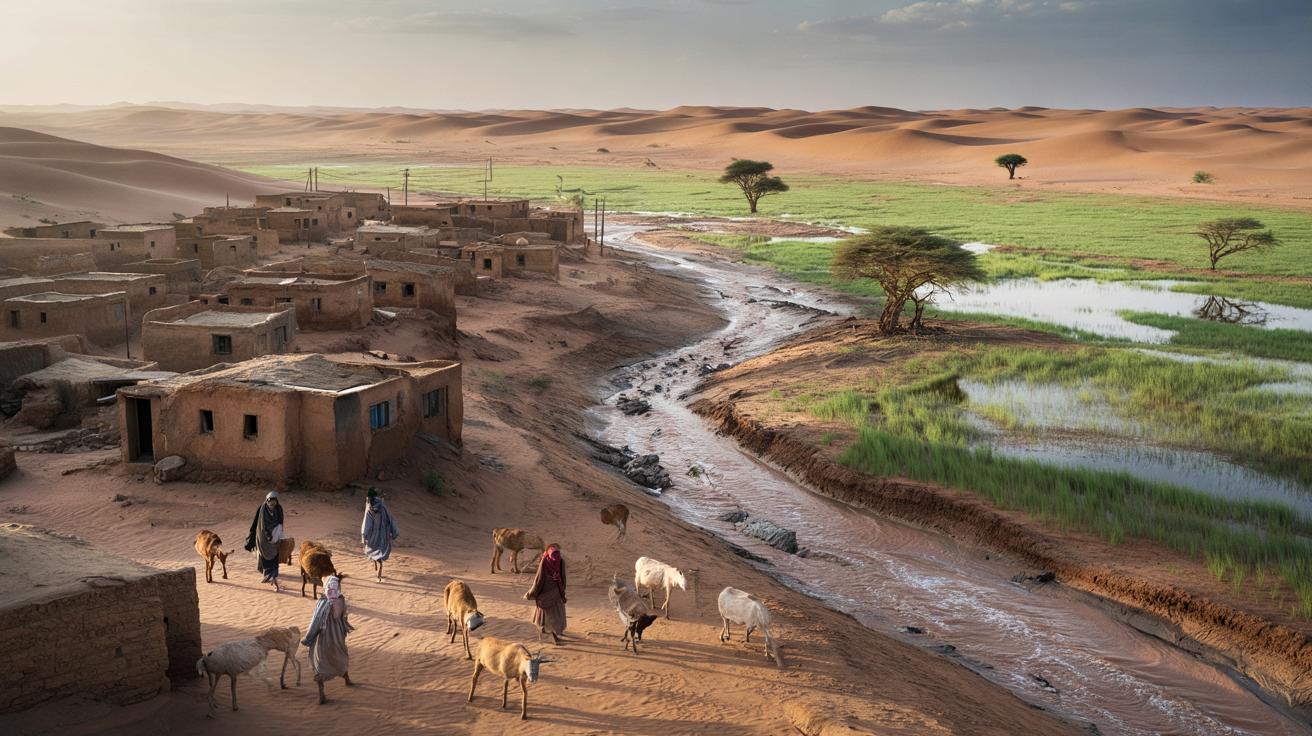
At the edge of the Sahara in southern Morocco, dawn does not really arrive with birdsong. It arrives with heat. By seven in the morning, the air already feels like someone has opened an oven door, and the horizon shimmers where the sand blurs into sky. A few scraggly acacia trees cling on, their roots chasing moisture that barely exists anymore. The village well goes a little deeper every year. Old people say the same thing: “The desert is coming.”
Now a new generation of scientists is saying something far more unsettling. The desert might not only be “coming” – it could be changing completely. And if rare climate patterns tip just a little too far, excess rainfall could turn the Sahara green again.
That sounds like good news. It might not be.
When a desert remembers it was once green
Stand on a dune in Niger or Egypt and it’s hard to imagine that, a few thousand years ago, this same landscape was dotted with lakes, grasses, even crocodiles. The Sahara, the largest hot desert on Earth, was once a sprawling savanna, alive with herds, rivers and human settlements. Today, the silence feels permanent. The wind erases footprints in minutes. Planes cross it in hours, but for the people living on its edges, the desert is a slow, relentless pressure.
Climate researchers say that pressure may be about to flip. Not gradually. Not gently. But in abrupt swings that could flood parts of the Sahara with excess rainfall and turn the land from sand back to shrubs at a speed that would shock any policymaker.
You can still see traces of the “Green Sahara” in satellite images. Dark stains on the sand where ancient riverbeds once carved through what is now bare rock. Archaeologists have dug up fish bones and hippo remains thousands of kilometers from any modern water source. In Chad’s Ennedi Plateau, rock art shows people swimming where there is now only rock and dust. This is not fantasy. It is climate memory carved into the landscape.
A recent modeling study warns that if global warming destabilizes monsoon systems, parts of North Africa could receive several times their current rainfall. Not soft, gentle showers, but violent, seasonal bursts. Flash floods that rip through dry wadis. Temporary lakes returning in basins where no one has farmed for centuries. A rapid greening that looks promising in photos, yet comes with a dangerous twist.
The twist is simple: deserts are not just empty spaces. They are anchors in the world’s climate machine. When a bright, sandy surface is suddenly covered by darker vegetation, it absorbs more heat. That extra heat feeds back into the atmosphere, shifting winds and moisture routes. Rain that once fell over the Sahel might be dragged north, leaving fragile farming communities exposed to a new kind of roulette. *Climate models show that once this shift starts, it can lock into a new state for centuries.*
That’s why scientists talk about “tipping points.” Not because they like drama, but because the Sahara doesn’t move in slow, polite lines. It jumps.
Too much rain in a land built around scarcity
At first glance, more rain in North Africa sounds like a blessing. Ask a farmer on the outskirts of Nouakchott in Mauritania or in northern Mali, and they’ll tell you rain is the difference between staying and leaving. Between paying school fees and sending a child to a city across the border. The Sahel has been through brutal droughts already, from the 1970s onward, and those scars are still visible in migration routes and half-abandoned villages.
➡️ Bad news for homeowners: starting March 15, a new rule bans lawn mowing between noon and 4 p.m.
Yet the new research suggests a different trap: **a world where rainfall doesn’t simply “increase” but jumps, shifts and concentrates**. Towns built on the assumption that it never rains hard might suddenly face floodwaters carving through streets that never had drains. Roads, wells, and power lines designed for dust and heat, not torrents, could fail fast.
We’ve all been there, that moment when something you’ve always lacked finally arrives – and you realize you’re not ready for it. In Sudan and Niger, brief episodes of extreme rainfall in recent years have already swept away homes made of mud brick, drowning livestock and blocking access to food markets. In 2020, Sudan declared a national state of emergency after floods destroyed tens of thousands of houses. These were not monsoon countries, yet they were hit by monsoon-scale chaos.
Now imagine this pattern stretched over a much larger area. Lakes swelling in low-lying basins of Libya. New wetlands forming along the Algerian border. Nomadic routes cut by unexpected water bodies. For global headlines it will look dramatic, even hopeful. For local administrators with thin budgets and no early-warning systems, it will look like a logistical nightmare.
The balance across Africa is already stretched. Food imports are rising. Power grids buckle under heatwaves. Coastal cities from Dakar to Alexandria fight back the sea while rural areas hollow out. Shift the Sahara’s climate suddenly and that balance could snap. **Rainfall that feeds vegetation in the north might come at the expense of already fragile zones in the south.** Farmers in the Sahel who adapted – painstakingly – to drier conditions may find their strategies mismatched overnight.
Let’s be honest: nobody really reads the fine print of climate risk reports every single day. Yet buried in those graphs is a plain warning – the Saharan system does not change neatly from “bad” to “good.” It can overshoot. It can turn rainfall into a weapon on already vulnerable communities, pushing them into new conflicts over who controls fresh water, who gets land as it greens, and who is left stranded on the wrong side of a new climatic border.
How to prepare for a desert that might bloom too fast
So what do you do when the future is a moving target? For governments and communities across North Africa and the Sahel, the first step is almost boring: map the risk, street by street. That means combining satellite data, local rainfall records and community observations to find the exact places that flood first when a big cloudburst hits. A dry riverbed behind a school. A low-lying market. A road that always turns into a temporary lake.
From there, basic climate defenses become a survival toolkit. Raised homes. Simple drainage channels that can be dug with shovels, not just heavy machinery. Grain storage that sits above flood level. These are not shiny megaprojects. They are the unglamorous adjustments that decide whether excess rain becomes life or loss.
There’s also a social dimension that technical reports tend to gloss over. When land greens, it attracts people. Old grazing disputes can flare. Lines on maps that once divided “useful” land from “waste” are suddenly worth fighting over. Anxious governments might rush to fence off “new fertile zones” for agribusiness, pushing aside the very communities that survived the worst years of drought.
An empathetic approach starts from the ground up. Listen to pastoralists who know every hollow and hill. Support women’s groups who already manage water points and fields in times of stress. Invest not just in meteorological stations, but in local radios and WhatsApp alert groups that can say, bluntly: big storm tonight, move your animals, move your kids. That’s the scale where resilience is real.
The researchers behind the new study are not just warning about rainfall; they’re warning about shock. One of them told me, half-exhausted after a night with satellite data:
“People imagine a green Sahara as this postcard of happy camels in lush grass. What we see in the models is turbulence. If we don’t plan ahead, the first winners are going to be chaos and inequality.”
To avoid that, leaders and citizens can push for a few concrete safeguards:
- Early warning systems for both drought and flash floods, linked to local languages and tools.
- Land-use rules that protect communal grazing and prevent sudden land grabs when new areas green up.
- Regional agreements on shared rivers and aquifers, before new water ignites old rivalries.
- Investment in climate-smart crops that can handle both dry spells and waterlogging.
- Support for youth so migration is a choice, not a forced escape from climate whiplash.
These aren’t magic bullets. They are, at best, a fragile seatbelt in a car that’s already starting to skid.
A continent standing at the edge of a moving desert
The idea that excess rainfall could remake the Sahara sounds like speculative fiction, the kind of storyline you’d expect in a streaming series rather than a peer‑reviewed paper. Yet the science keeps circling back to the same uncomfortable thought: the desert remembers being green, and under the right – or wrong – conditions, it can rush back there. The question is not only “will it?” but “who will be ready if it does?”
Africa’s fragile balance rests on quiet assumptions: that rains arrive roughly when they used to, that deserts stay where maps say they are, that today’s risks resemble yesterday’s. A wetter Sahara would tear through those assumptions. It might offer new chances – pasture where there was none, crops where there was sand – but also fresh fractures in societies already stretched by debt, conflict and heat.
For people scrolling climate headlines on a phone in Lagos, Paris or Nairobi, this can feel distant. A faraway desert, a hypothetical future. Yet the same atmospheric gears that might shift the Sahara’s rainfall also steer storms in Europe and heatwaves in Asia. The Sahara is not just a backdrop. It’s a giant regulator, and when regulators behave wildly, the ripples rarely respect borders.
Maybe the most honest response is to drop the fantasy of “good” and “bad” climate change and replace it with a harder question: are we building systems – from farms to cities to diplomacy – that can bend with sudden change without breaking? The Sahara may yet bloom again. Whether that becomes a story of renewal or rupture will depend less on the clouds, and more on what we do before they finally burst.
| Key point | Detail | Value for the reader |
|---|---|---|
| — | The Sahara has flipped between desert and green savanna in the past, often abruptly. | Helps you see current change as part of a known, high‑risk pattern, not a wild guess. |
| — | Excess rainfall could trigger rapid greening but also destructive floods and social tension. | Shows why “more rain” in dry regions isn’t automatically good news. |
| — | Local preparation – drainage, early warnings, fair land rules – can turn shocks into chances. | Offers concrete levers citizens and leaders can push for right now. |
FAQ:
- Question 1Is it really possible for the Sahara to turn green again in our lifetime?Yes, not as a full tropical garden, but parts of the Sahara could see major greening this century if monsoon patterns shift and rainfall increases sharply, as some climate models suggest.
- Question 2Would more rain in the Sahara solve Africa’s food crisis?Not automatically. New fertile zones might appear, but without fair land access, infrastructure and flood‑resistant farming, the benefits could bypass the poorest communities.
- Question 3How does the Sahara affect weather in Europe and other regions?The Sahara’s dust, heat and high‑pressure systems help shape storm tracks and temperature patterns far beyond Africa, influencing heatwaves and rainfall in Europe and even parts of Asia.
- Question 4What can local communities realistically do about such a huge climate shift?They can push for flood mapping, early‑warning systems, safer housing, and land rules that protect traditional users, while sharing their on‑the‑ground knowledge with scientists and officials.
- Question 5Is this “excess rainfall” scenario guaranteed to happen?No, it’s a risk, not a certainty. It depends on how global emissions, ocean temperatures and monsoon systems evolve – but it’s serious enough that researchers say planning should start now.